Eros Before Cupid: Desire at the Beginning of the Greek Cosmos
5 min read·4 views·Aug 14, 2026
TL;DR
Eros appears near the beginning of the cosmos in Hesiod, but Greek tradition never fixed one genealogy or appearance. Cosmic, cultic, artistic, and philosophical accounts each used Eros to explain attraction, generation, and desire.
Eros Before Cupid: Desire at the Beginning of the Greek Cosmos
The familiar image of Eros is a winged boy armed with a bow. Greek tradition,
however, also preserves a much older and stranger idea: Eros as a power present
near the beginning of the cosmos. This is not a single biography with one fixed
family tree. It is a group of poetic, religious, philosophical, and artistic
traditions that use Eros to explain how attraction and generation make an
ordered world possible.
Eros in Hesiod's first generation
In Hesiod's Theogony, Eros appears in the opening sequence of creation. Chaos
comes first, followed by broad-breasted Gaia, Tartarus, and Eros. Hesiod calls
Eros the most beautiful among the immortal gods and describes a force that
loosens limbs and overcomes the mind and counsel of gods and humans.
That placement matters. Hesiod does not call Eros a Titan. The Titans belong to
a later generation, born from Gaia and Uranus. Nor does Hesiod say that Nyx
gave birth to Eros: his catalogue of Nyx's children names powers such as Doom,
Death, Sleep, and Strife, but not Eros. In the opening cosmogony, Eros simply
appears among the earliest realities without a stated parent.
Hesiod's Eros is therefore more than romantic affection. He represents the
compelling attraction that allows beings to unite and generations to follow.
The poem does not give him a long sequence of adventures. His importance lies
in what his presence makes possible.
Night, the cosmic egg, and a winged Eros
Another cosmogonic image survives in the chorus of Aristophanes' comedy Birds.
In that playful account, black-winged Night produces an egg in the depths of
Erebus. From it emerges a swift Eros with golden wings, who joins with winged
Chaos and begins a chain of generation.
The passage is often discussed beside Orphic cosmogonies, where a radiant
primeval figure associated with an egg may be called Phanes, Protogonos, or
Eros. But the evidence must be handled carefully. Birds is a comedy, not a
complete Orphic scripture, and the surviving Orphic material belongs to
different dates and versions. It proves that an egg-born cosmic Eros was an
intelligible ancient image; it does not give us one universally accepted Greek
creation story.
Stay Curious
Get the most fascinating stories from history, science, and mythology — delivered weekly.
One name, several genealogies
Later texts do not preserve a clean division between two standardized gods
with different spellings. The same Greek name, Eros, can belong to different
genealogies and ideas.
Plato's Symposium makes the disagreement part of its design. Phaedrus praises
Eros as one of the oldest gods and invokes the authority of Hesiod. Agathon,
by contrast, calls him the youngest. In Diotima's philosophical account, Eros
is not a comfortably perfect god at all but an intermediary spirit, born from
Poros (Resource) and Penia (Poverty) during the celebration of Aphrodite's
birth. That genealogy is an allegory for desire: Eros lacks what he seeks yet
has the ingenuity to pursue it.
Other traditions connect Eros directly with Aphrodite, producing the youthful,
bow-bearing figure familiar from later poetry and art. Calling the cosmic form
"elder Eros" can be a useful modern explanation, but ancient traditions were
not governed by a single canon that always separated two individual beings.
Worship and images
Eros was not only a literary abstraction. Pausanias reports that the people of
Thespiae honored Eros above other gods and possessed a very ancient image of
him in the form of an unwrought stone. The same sanctuary later displayed
celebrated sculptural images. This contrast is revealing: there was no single
timeless portrait. An aniconic stone, a beautiful youth, a winged child, and a
cosmic power could all belong to the reception of Eros in different settings.
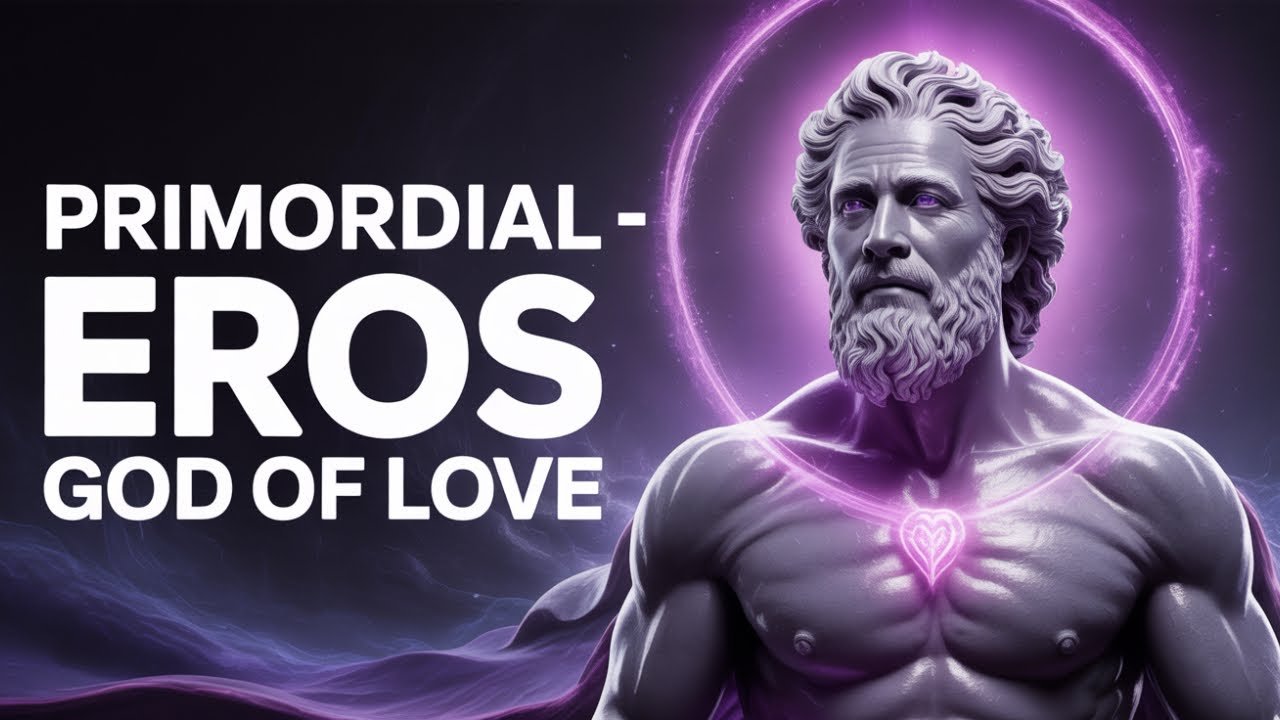
For that reason, modern cover art should be read as interpretation rather than
evidence of a canonical primordial body.
What the surviving sources do not say
The recovered video transcript adds a Titan allegiance, a role in preventing
conflict before the Titanomachy, involvement in an agreement over the division
of the universe, and a connection to the release of Typhon. These details are
not found in the cited Hesiodic passages. The transcript also assigns Eros a
role in Zeus's union with Semele that Hesiod does not attribute to him.
Those additions turn a sparse cosmogonic power into a modern narrative
character. The ancient evidence supports a different conclusion: Eros was
important precisely because Greek authors could use him in multiple ways—as
primordial attraction, generative force, god of love, cosmic winged being, and
philosophical desire.
The oldest lesson of Eros
Hesiod places Eros near the beginning because a populated cosmos needs more
than matter and space. It needs attraction, union, and succession. Later poets
and philosophers changed his birth, age, appearance, and status, but they kept
returning to the same problem: desire moves beings beyond themselves and makes
new life, relationships, and ideas possible.
The primordial Eros is therefore not simply Cupid made older. He is an ancient
answer to a cosmic question—what draws a divided universe together?