Tartarus: The Primordial Abyss Beneath the Greek World
4 min read·4 views·Aug 13, 2026
TL;DR
Tartarus begins in early Greek poetry as a primordial cosmic depth and prison for divine enemies, distinct from Hades. Later traditions, including Plato, connect it more strongly with punishment after death.
Tartarus: The Primordial Abyss Beneath the Greek World
Before Tartarus became shorthand for a place of punishment, Greek poetry imagined it as something older and stranger: a primordial depth at the limits of the cosmos. It was not simply another name for Hades, and the earliest surviving sources do not present a muscular underworld king who personally judges every soul. Tartarus begins as both a named cosmic reality and an abyss so remote that even the gods fear it.
Tartarus at the beginning of creation
In Hesiod's Theogony, Tartarus appears near the opening of the creation account. Chaos comes first, followed by broad-bosomed Gaia, dim Tartarus in the depths of the earth, and Eros. This places Tartarus among the fundamental conditions of the universe rather than among the later Olympian gods.
The grammar allows Tartarus to be personified, and later genealogical traditions could treat primordial places as beings. Yet the surviving early narrative usually makes Tartarus act most clearly as a location. It is not identified as one of the Titans. On the contrary, Tartarus is where the defeated Titans are imprisoned after their war with Zeus.
A prison below the world of the dead
Homer and Hesiod both emphasize impossible distance. In Book 8 of the Iliad, Zeus threatens to throw a disobedient god into dark Tartarus, behind iron gates and a bronze threshold. The poem places it as far beneath Hades as heaven stands above the earth.
That comparison matters. Hades is the realm associated with the ordinary dead; Tartarus lies deeper still. Treating the two as perfectly interchangeable erases an important distinction in early Greek cosmology.
Hesiod develops the image further. The Titans are bound beneath the earth, and the Hundred-Handers guard them. Elsewhere the poem describes the roots and limits of earth, sea, heaven and Tartarus in a terrifying boundary region associated with Night. Tartarus is therefore more than a dungeon built inside an already ordered underworld. It belongs to the architecture of the cosmos.
Stay Curious
Get the most fascinating stories from history, science, and mythology — delivered weekly.
Was Tartarus a god or a place?
The safest answer is that Greek myth does not force a modern either-or choice. Gaia is both Earth and a divine figure; Nyx is both Night and a goddess. Tartarus can likewise be named and genealogically personified while remaining, in most of the relevant stories, a vast place.
This does not support a detailed biography of Tartarus as a universal judge, guardian of portals or "jailer of the cosmos." Those characterizations belong to modern storytelling. Early poetry gives the work of guarding the imprisoned Titans to figures such as the Hundred-Handers. Judgment of mortal souls is associated with other named judges in later afterlife traditions.
From divine prison to moral punishment
The meaning of Tartarus changed as Greek ideas about the afterlife developed. In early epic it is especially a prison and threat for divine enemies: Titans or gods who might defy Zeus. It is not yet a systematic hell where every wicked human receives a sentence.
By the time of Plato, Tartarus could appear within a moral geography of the afterlife. In the closing myth of the Gorgias, souls are judged after death. Some wrongdoers are sent to Tartarus for punishment; punishment may correct those who can still improve, while incurable offenders serve as examples to others.
This later use explains why Tartarus eventually became strongly associated with the punishment of wicked mortals. But chronology matters. Plato's philosophical myth should not be projected backward as the personal biography of a primordial god in Hesiod.
What the existing video gets wrong
The historical video captures the darkness, distance and terror associated with Tartarus, but several claims do not come from the Greek sources reviewed here. Tartarus is not a member of the Titan race. Valhalla belongs to Norse tradition, not Greek cosmology. The ancient texts do not describe Tartarus as pure energy, as the final judge of every dead soul, or as an eternal enforcer of universal balance.
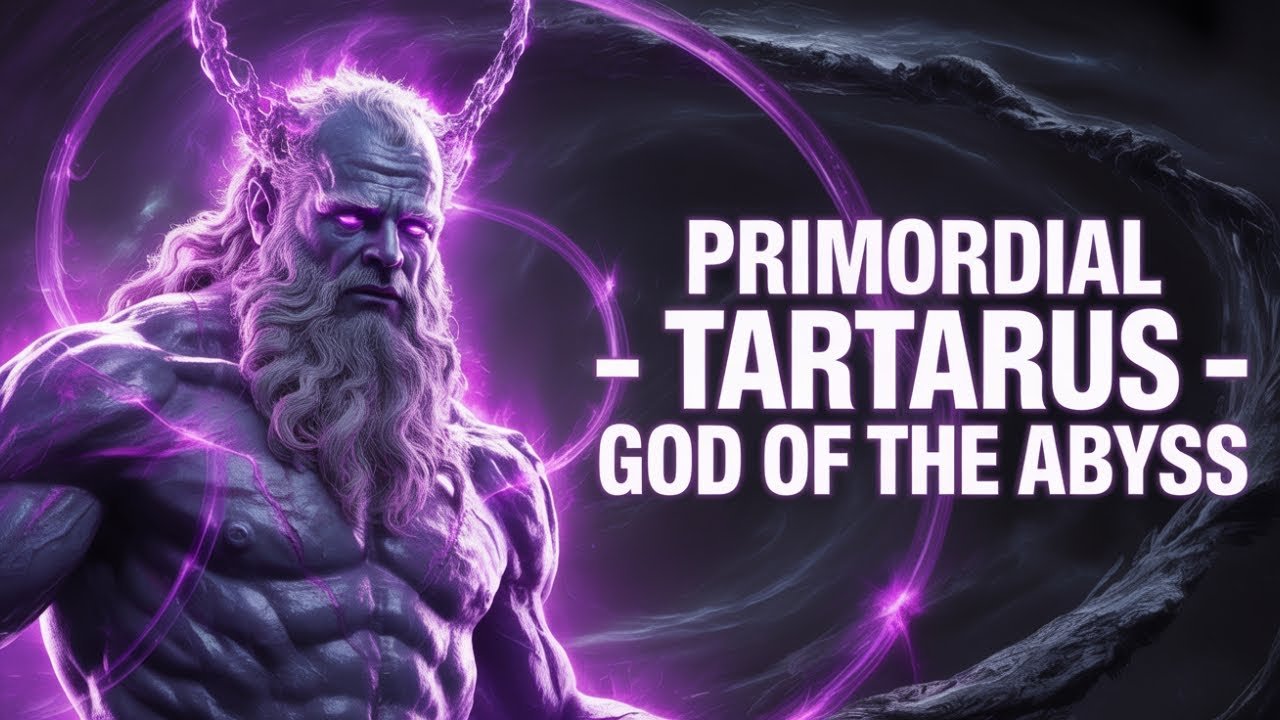
The video's cover is likewise a modern visual interpretation. Ancient poetry gives us an abyss, gates, a bronze threshold and cosmic darkness, not one universally accepted humanoid portrait of Tartarus.
The abyss as a cosmic boundary
Tartarus endured because it could express several forms of fear at once: the depth beneath the known world, the prison from which divine enemies could not escape, and eventually the destination of exemplary punishment. Its mythology accumulated rather than remaining fixed.
To understand Tartarus historically, keep the layers separate. Hesiod gives us a primordial depth and the prison of the Titans. Homer measures its terrifying distance beneath Hades. Later thinkers such as Plato make it part of a morally ordered afterlife. The familiar image of "Greek hell" grows from those layers, but it should not replace them.