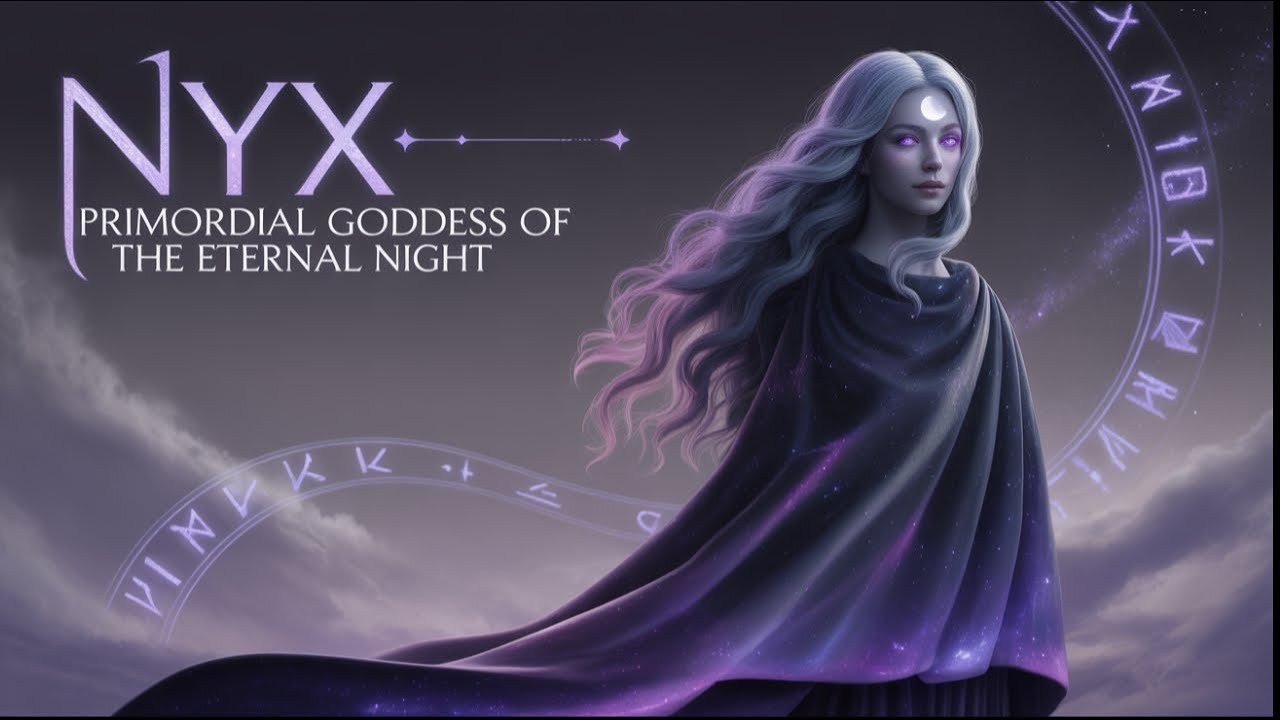
Nyx is Night personified in early Greek poetry. Hesiod places her near the beginning of creation and makes her mother of Sleep, Death, Dreams, and other forces, while Homer shows Zeus afraid to offend her.
Before the Olympian gods ruled the cosmos, Greek poetry imagined Night as a power with ancestry, children and a place at the edge of the ordered world. Nyx is not merely a goddess who operates after sunset. Her name is the Greek word for night, and early poems treat her as Night personified.
The surviving sources provide something stranger than the detailed biography often repeated online. They place Nyx near the beginning of creation, make her the mother of forces that shape mortal existence, and even show Zeus hesitating before her power.
Nyx emerges from Chaos
In Hesiod's Theogony, Chaos comes first. From Chaos arise Erebus and black Night. Nyx and Erebus then produce Aether and Day. The genealogy moves from nether darkness and night toward brightness and daylight, expressing cosmic relationships through a divine family.
Nyx and Erebus are siblings in this account, but the text does not call them twins. Hesiod gives a compact genealogy rather than a story about Nyx covering the world with a literal starry cloak.
The children of Night
Hesiod later presents Nyx as the sole parent of a remarkable group of personifications. The list includes Doom, Fate, Death, Sleep, Dreams, Blame, Woe, the Hesperides, the Fates, Nemesis, Deceit, Old Age and Strife. Strife then produces another generation of suffering and conflict.
This corrects a common error. Aether and Day belong to the union of Nyx and Erebus, while Sleep, Death, Dreams and many other children are born from Night without a partner in Hesiod's account. Morpheus does not appear in this Hesiodic list as a child jointly assigned to Nyx and Erebus.
Stay Curious
Get the most fascinating stories from history, science, and mythology — delivered weekly.
The genealogy is not simply a catalogue of evil. Sleep can be gentle, while Death is relentless. Night becomes the setting from which rest, dreams, mortality, uncertainty and conflict can all be imagined.
Why even Zeus respects Nyx
Nyx's power is clearest in Book 14 of Homer's Iliad. Sleep recalls how he once angered Zeus and escaped by taking refuge with Night. Zeus stopped his pursuit because he feared doing something displeasing to her.
The episode does not make Nyx queen of Olympus or ruler of the underworld. It does show that her authority reaches beyond a decorative personification. Within the poem, Night can shelter another divine power from Zeus himself.
The house shared by Night and Day
Hesiod places the house of murky Night near the remote limits of earth, Tartarus, sea and heaven. Night and Day meet at its threshold but never occupy the house together: one travels over the world while the other waits inside. Sleep and Death also dwell in this dark region.
This is more precise than saying simply that Nyx lives in Tartarus. The passage creates a cosmic boundary near Tartarus and describes the alternation of Night and Day through movement at a shared threshold.
What the ancient sources do not establish
The recovered video associates Nyx with protection, witchcraft, potion-making, bats, owls, the moon, flowers and fixed visual attributes. These ideas may suit modern fantasy, but the primary passages reviewed here do not establish them as one ancient tradition.
Ancient and later art could represent Night as a woman, sometimes winged or moving across the sky, and nocturnal scenes could use torches or related deities. That varied visual history should not be reduced to one mandatory portrait. The existing video cover is a modern interpretation rather than a reconstruction of a specific ancient artwork.
The enduring power of Night
Nyx remains memorable because she occupies several levels at once. She is a word for night, a primordial personification, a mother in a cosmic genealogy and a power respected by Zeus. Her children connect darkness with sleep, dreams, death, fate and uncertainty without making every aspect of night evil.
Read closely, Nyx is less a fantasy sorceress than a poetic answer to a basic question: how can the recurring darkness that surrounds every human life be given a place in the order of the universe?
The primordial sequence continues with Tartarus, both a cosmic power in early genealogy and the immense depth beneath the earth.