Erebus: Primordial Darkness and the Greek Underworld
4 min read·6 views·Aug 13, 2026
TL;DR
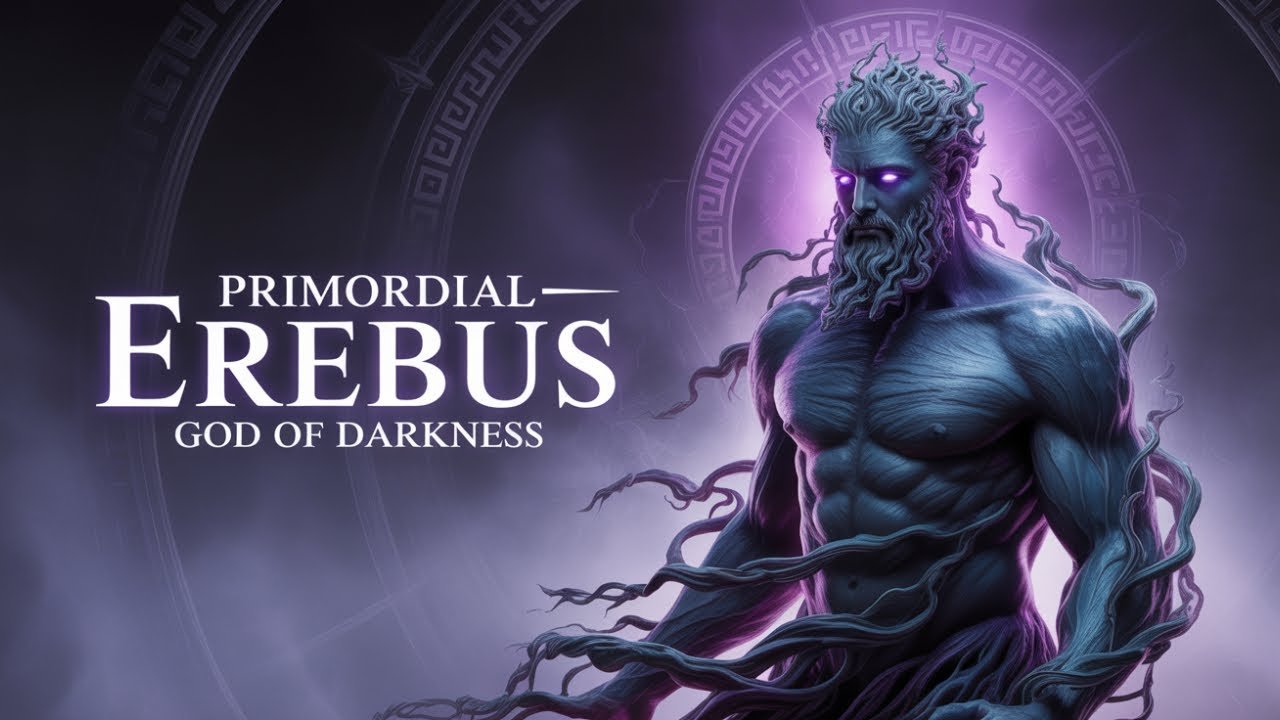
Erebus is both a primordial personification in Hesiod and a name for nether darkness in Homer. Ancient sources do not make Erebus a judge or ruler of the dead. This historical companion article preserves the existing video and audio.
Before the gods ruled from Olympus, Greek poetry imagined powers that belonged
to the structure of the cosmos itself. Among them was Erebus: a name associated
with deep darkness, ancestry, and the road toward the world of the dead.
Calling Erebus simply “the god of darkness” is convenient, but incomplete.
Ancient sources use the name in more than one way. In Hesiod, Erebus takes part
in a divine genealogy. In Homer, Erebus can describe a dark underworld region
or direction. The personification and the place are connected, but they should
not be silently treated as the same claim.
Erebus in Hesiod's genealogy
In Hesiod's Theogony, Erebus and black Night emerge from Chaos. Night later
gives birth to Aether and Day after union with Erebus. The passage places
darkness and night near the beginning of the cosmos and then sets brightness
and day beside them in the next generation.
This is genealogical language: Erebus has an origin and participates in the
birth of other cosmic powers. It is reasonable to describe Erebus as a
personification of deep darkness, or as a primordial divine power. The passage
does not, however, provide the detailed biography often found in modern
retellings. It gives Erebus no throne, weapon, cult narrative, or office as a
judge of human souls.
The family relationship must also remain precise. Hesiod's passage supports
Aether and Day as the children associated with the union of Night and Erebus.
It does not justify assigning every later child of Night—including Sleep and
Death—to Erebus as a father.
Erebus as a region of darkness
Homer's Odyssey shows another use of the name. During Odysseus's journey
toward the dead, Erebus functions spatially: it is the dark direction or region
from which the shades emerge. Elsewhere, a cave is described in relation to
the way toward Erebus.
Stay Curious
Get the most fascinating stories from history, science, and mythology — delivered weekly.
This does not turn Erebus into a ruler competing with Hades. In the underworld
ritual described in Book 10, Odysseus addresses Hades and Persephone. Erebus
marks the nether darkness or passage associated with that realm. Historical
lexicons preserve this range, defining the word through underworld darkness
and the dark region or route toward Hades.
The distinction matters. A place can be expressed through the same mythic
vocabulary as a personified cosmic force. Greek poetry did not need to keep
modern categories such as deity, condition, and location perfectly separate.
Our explanation should preserve that flexibility instead of inventing a single
biography that solves it.
What the sources do not establish
The recovered video transcript contains several dramatic claims that the
reviewed evidence does not support. Erebus is not identified in these sources
as one of three judges of the dead. They do not describe him taking dragon or
giant forms, maintaining a special working partnership with Hades, or ruling
an independent kingdom inside the underworld.
The proposed derivation of the name from a Greek exclamation is also not
supported by the lexical source reviewed for this article. When an etymology is
uncertain, uncertainty is more accurate than a memorable invented origin.
Modern writers can use Erebus as an image for fear, the unconscious, shadow,
or the unknown. Such comparisons may be valuable, but they are modern
interpretations. They should not be presented as psychological doctrines
taught by Hesiod or Homer.
Why Erebus remains compelling
Erebus stands at a boundary. In one early poem, deep darkness belongs to the
family tree of the universe. In another, the same name helps locate the
terrifying path toward the dead. Darkness is therefore more than an empty
background: it has ancestry, direction, and a place in the architecture of the
cosmos.
That layered identity is more interesting than a catalogue of invented powers.
Erebus can be approached as a primordial personification when we follow
Hesiod, and as nether darkness or an underworld region when we follow Homer.
Keeping those uses visible allows the myth to remain mysterious without making
it falsely certain.
The next figure in the primordial sequence is Nyx, Night herself—a power whose
genealogy expands darkness into an entire family of forces shaping mortal life.